All Articles
Enrichment of Gold Veins
November 2000 by Edgar B. Heylmun, PhD
 Most of the world's great gold mines are in secondary (supergene) enrichments in veins and stockwork, brought about by physical and chemical processes.
Additional articles that might interest you...
Mining for Gemstones and Mineral Specimens
August 2013
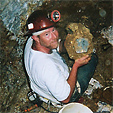 It is better in a gem and mineral mining operation that the driller, blaster and mucker be the same person in order to be able to predict placement of the desired mineral enriched pockets.
Platinum Claims on Heines Creek
April 2002
There aren’t too many workable placer deposits of platinum in the world today. Most of the platinum found is in hardrock lodes, usually mixed in the gold, silver or copper outcrops.
There aren’t too many workable placer deposits of platinum in the world today. Most of the platinum found is in hardrock lodes, usually mixed in the gold, silver or copper outcrops.
Finding Gold with a VLF Detector—Part III
June 2014
 The higher the sensitivity setting, the louder and sharper the signal from a gold nugget or other metal target.
Ask The Experts—Precious metals in water?
February 2011
How can I determine if there are precious metals in the groundwater?
How can I determine if there are precious metals in the groundwater?
Life in the Alaska Gold Rush
July 2007
The discovery of gold in the Klondike in August 1896 brought a rush that became a bonanza for a few, and hardship and disaster for many. The remoteness of the discovery site, and the extremely harsh climate made the effort to recover gold foolhardy for all but the most prepared.
The discovery of gold in the Klondike in August 1896 brought a rush that became a bonanza for a few, and hardship and disaster for many. The remoteness of the discovery site, and the extremely harsh climate made the effort to recover gold foolhardy for all but the most prepared.
The Small Hardrock Mill—Part II
August 2006
Welcome back to our mining claim. In part one we located our claim, sunk our shaft, and stored some ore in the ore bin. Now we must decide how we are going to extract the gold. We briefly discussed setting up a lab in a 40-foot semi-trailer at the mine site, so let’s decide what we are going to need in the lab.
Welcome back to our mining claim. In part one we located our claim, sunk our shaft, and stored some ore in the ore bin. Now we must decide how we are going to extract the gold. We briefly discussed setting up a lab in a 40-foot semi-trailer at the mine site, so let’s decide what we are going to need in the lab.
Subscription Required:
The Bawl Mill
• Our Readers Say
• The Assay of High Iron Gold Ores
• The Patch
• History of Mining—Bradshaw Mountains, AZ (Part I)
• Picks & Pans—The Green Rock, Rattlesnakes, Good Gold and Ruth's Mine
• The Oretron
• Silver Hill, North Carolina
• Residual, Lateritic and Gossan "Soils" as Potential Nuggetshooting Sites
• Hardrock in Downieville
• Looking Back
• Company Notes
• Gold in Northern Baja California
• California State Gold Panning Championship Results
• Melman on Gold & Silver
• V.P. Contender Addresses Mining Show