Legislation & Regulation
Legislative and Regulatory Update
July 2012 by Scott Harn


The Forest Service has proposed using categorical exclusions to the National Environmental Policy Act (NEPA) to remove “water control structures, such as dikes, ditches culverts and pipes, restore lands and habitat to predisturbance conditions to the extent practicable by removing debris, sediment, and hazardous conditions following natural or human-caused events; and restore lands occupied by roads and trails to natural conditions. The proposed road and trail restoration category would be used for restoring lands impacted by non-system roads and trails that are no longer needed and no longer maintained.”
The federal government will undoubtedly use this tool to further restrict access to public lands by mining claim holders and other public land users. Through the use of Travel Management Plans, the Forest Service has already been systematically locking off roads and trails throughout the West, including some that have been in use for decades.
With this latest proposal, the Forest Service is taking the next step towards implementing the plans set forth in Agenda 21 and the Wildlands Project. These two initiatives are largely responsible for the extremely restrictive regulations put forth by the federal government over the past two decades.
It all starts with “sustainable development.” The term “sustainable development” was first introduced in 1987 by The Brundtland Commission on Environment and Development, headed by Gro Harlem Brundtland, Vice President of the World Socialist Party. “Sustainable development” is a fancy term that means followers will preserve the environment while limiting economic growth to human needs, with priority given to the world’s poor—those who already have their essential needs met, i.e. citizens in the United States and other developed countries, will bear the cost.
Agenda 21 was born in 1992, at the United Nations Earth Summit in Rio De Janeiro. That’s where 178 world leaders signed on to support the vague idea of “sustainable development.” Soon after, the Forest Service changed their focus from multiple use to sustainability—they have a website dedicated to this goal at: www.na.fs.fed.us/sustainability
Presidents Clinton, George H. W. Bush, and Obama have all signed executive orders implementing portions of Agenda 21, though it has never been approved by Congress. President Bush signed the Rio Accord, and President Clinton subsequently established the President’s Council for Sustainable Development (Executive Order #12858) which required guidelines for Agenda 21 to be established and administered by the federal government across all departments.
The United Nations created the International Council of Local Environmental Initiatives (ICLEI) to implement their plans with the help of non-governmental environmental organizations, state, local and federal governments. There are literally hundreds of non-governmental organizations involved now, including The Nature Conservancy, Sierra Club, National Wildlife Federation, Environmental Defense Fund, National Education Society, and Planned Parenthood, to name a few. By attaching grant money and other funds to desired projects and outcomes, our federal government has been able to circumvent Congressional approval and keep much of the public in the dark.
Some of the less publicized goals of Agenda 21 include redistribution of wealth and population control. Full information on Agenda 21 and the Wildlands Project are easily available with a simple Internet search.
The Forest Service proposal on categorical exclusions was published in the Federal Register on June 13. Comments are being accepted until August 13. We highly recommend sending a copy of your comments to your state and federal legislators.
Comments can be faxed to (801)397-1605 or submitted online at: www.regulations.gov attention “Categorical Exclusions.”
• 9th Circuit Court deals blow to small miners
The 9th Circuit Court of Appeals ruled that the Forest Service must consult with other agencies prior to approving a Notice of Intent for suction dredging.
The case was an appeal filed by the Karuk Tribe and environmentalists following the approval of a Notice of Intent for suction dredging in northern California back in 2004 for The New 49ers mining club.
From attorney James Buchal, who represented The New 49ers:
“I am sorry to say that the Ninth Circuit has, by a vote of 7-4, determined that Forest Service review of a miner’s Notice of Intent triggers a duty to engage in Endangered Species Act consultations. The earlier panel opinion to the contrary was overturned. This en banc opinion ignores many of the relevant arguments we presented, misrepresents the facts and law, and even goes so far as to omit us from the list of counsel participating.
“The decision triggered a remarkable, forceful and even illustrated dissent, suggesting that citizens have entered into a particular hell (‘Abandon all hope, ye who enter here’) wrought by the majority’s abandonment of the rule of law in this and other environmental cases.
“I hope that The New 49’ers will find support from the mining community to seek Supreme Court review of this shabby decision.”
A copy of the decision is available at http://www.ca9.uscourts.gov/datastore/opinions/2012/06/01/05-16801.pdf

© ICMJ's Prospecting and Mining Journal, CMJ Inc.

Additional articles that might interest you...
Wake Up Voters! Oregon SB 838 Study Group Update
October 2014
They want to close our roads on public land (built by taxpayer funds) to keep us and our disabled veterans out. And it won’t stop with just mining.
They want to close our roads on public land (built by taxpayer funds) to keep us and our disabled veterans out. And it won’t stop with just mining.
Legislative and Regulatory Update
January 2019
- Zinke leaving office
- Property rights triumph over critical habitat says Supreme Court
- Water of the United States
Forest Service v. Michael & Linda Backlund
December 2010
On Tuesday morning, August 26, 2010, my clients Michael and Linda Backlund were forced to plead guilty to a charge of violating 36 CFR §261.10(b), which criminalizes maintaining a residence on Forest Service land without authorization “when such authorization is required.” This is a new regulation pursuant to which virtually anything, even a tent, is an unlawful “residence” unless authorized in advance.
On Tuesday morning, August 26, 2010, my clients Michael and Linda Backlund were forced to plead guilty to a charge of violating 36 CFR §261.10(b), which criminalizes maintaining a residence on Forest Service land without authorization “when such authorization is required.” This is a new regulation pursuant to which virtually anything, even a tent, is an unlawful “residence” unless authorized in advance.
Legislative and Regulatory Update
May 2013
• Battle continues in Oregon
• Stop annexation in Southern California
• EPA ignores Supreme Court ruling with new Idaho permit
• Alaska sues Feds to restore access rights
• California dredgers await next big court date
• Battle continues in Oregon
• Stop annexation in Southern California
• EPA ignores Supreme Court ruling with new Idaho permit
• Alaska sues Feds to restore access rights
• California dredgers await next big court date
BLM Raises Location and Claim Fees
August 2014
The Bureau of Land Management announced an increase in location filing fees and annual maintenance fees for unpatented mining claims, mill sites and tunnel sites.
The Bureau of Land Management announced an increase in location filing fees and annual maintenance fees for unpatented mining claims, mill sites and tunnel sites.
Legislative and Regulatory Update
September 2017
- PLF sues over critical habitat
- Attorney General ends EPA slush fund
Northwestern Alaska Mineral Resources
February 2016
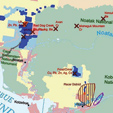 Gold and jade are actually only minor mineral resources for the Northwestern Alaska region as a whole. Modern prospecting has focused more on base metal than precious metal resources.
Gold and jade are actually only minor mineral resources for the Northwestern Alaska region as a whole. Modern prospecting has focused more on base metal than precious metal resources.
Subscription Required:
The Bawl Mill
• Gold Depositiion and Gradients of Placer Streams—Part II
• The Life of an Independent Prospector
• Gold in Guyana—Part I: Porknocking on the Puruni River Road
• That Something Extra
• Prospecting for Copper Ores—Part II
• Metallic Trash—Scourge of the Prospector
• Gold Mining Boom in the Carolinas
• California Suction Dredging Update
• Mine, Baby, Mine!
• Hecla to Reopen Lucky Friday Mine
• Nova Scotia Shows It's Serious About Jobs & Mining
• Melman on Gold & Silver
• Mining Stock Quotes and Mineral & Metal Prices
Free: