Prospecting & Detecting
Huge California Nugget A Hoax
August 2011 by Scott Harn


“We did a one-day mapping of the bedrock in this area with the expressed intent of finding concentrations of heavy gold based on the mining science of what river features cause gold to settle in certain areas,” Jim Sanders told us at the time. “...it was found in a deep crevice covered by ancient cemented rock. We literally had to chisel it out to get to the nugget,” he added.
Sanders, who also goes by the name of James Grill, sent photos to the Journal which purportedly showed historic tailing piles in the area where the nugget was located, along with a picture of the 98.6 troy ounce nugget laying in a hole on top of compacted gravels.
Sanders claimed he used ground-penetrating radar to survey his private property in Nevada County, California, and uncovered the chunk of gold with a backhoe when he was following up on one of the anomalies found by the radar.
Sanders had turned the nugget over to Holabird-Kagin Americana auction house in Reno. The specimen was marketed as the “Washington Nugget” after the small town of Washington in California’s Mother Lode where it was supposedly found. It was believed to be the largest surviving California nugget in existence, and it sold for $460,000 in March 2011.
Sanders was also having his property assessed for sale by the auction company when his story began to unravel. It seems a copy of our June 2010 issue made its way into the hands of Murray Cox over in Australia. He is the prospector who originally found the nugget near Ballarat in 1987.
Cox said he sold the nugget, named “The Orange Roughie” after the Australian fish, for $50,000 to a man in Arizona in 1989. He didn’t know how the nugget ended up in Sanders’ possession.
Cox contacted the auction company and provided them with photos and newspaper articles documenting the original find.
“The parties have mutually concluded that the nugget was from Australia,” said auction house owner Fred Holabird, who is also a mining geologist.
Holabird said the buyer received a refund and the nugget was subsequently sold to another bidder for a lower price.
Holabird added that the involved parties agreed that fraud charges against Sanders were not necessary.
We attempted to contact Sanders by phone, but the woman who answered stated they would not comment on the story. We also tried to reach him by email, but his account is no longer in service.
The price paid by the new buyer was not disclosed.


Springtime Sampling In The High Desert
 As the ground thaws and dries out and the warmth of spring starts to settle in, it’s time to start afresh with a new prospecting season.
Give That Club Claim A Chance
 My first trip to the claim was the tip-off that there might be larger gold to be found. I brought my puffer drywasher and my dad to a local prospecting club outing that was held at the claim.
Entry-Level Metal Detectors for Gold Prospecting
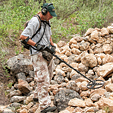 These are entry-level machines designed with gold prospecting in mind and with the ability to handle mineralized ground and see nuggets of a grain or so in size, perhaps smaller.
Detecting Alluvial Bench Deposits -- Pt II
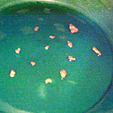 Walking around the gulch and exploring the upper drainage, picking up different rocks and inspecting them with a good loop, and looking them up in a field guide of rocks and minerals of your region will help you understand how the gold got there.
A Successful Trip Through Gold Basin
 This time we took the detectors. Roger had worked that spot very well and wanted to see if my new detector would uncover any gold he might have missed.
Placer Gold Deposits of Utah
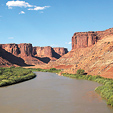 The placer deposits of Utah occur in two distinct types of environments. These are 1) placers found adjacent to, and derived from, gold, silver and base-metal deposits; and 2) placers found in major rivers and derived from unknown, distant sources.
Scams, Scammers and Schemes
Gold mining has received many black eyes from many scams, scammers and schemes throughout the years. Unscrupulous scammers have swindled naive people for millions of dollars in the past and will, no doubt, continue into the future.
Subscription Required:
The Bawl Mill
• Our Readers Say
• Legislative and Regulatory Update
• Ask The Experts—Studies with summaries and conclusions please...
• Ask The Experts—What's the cheapest way to mine quartz for gold?
• Which Specific Gravity Test Works Best?
• Critical Minerals: Gold
• Jury: Gov't Rightfully Seized 1933 Gold Coins
• So Where's The Gold?
• Wyoming's Billion Dollar Nugget—The Trilogy Ends
• When Legends Were Made and Fortunes Found
• Exploring and Mining for Uranium
• Melman on Gold & Silver
• Mining Stock Quotes & Mineral and Metal Prices