All Articles
Picks & Pans: All That Glitters Pans Out Well!
August 2001 by Mary-Anne Smith
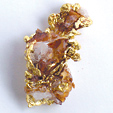
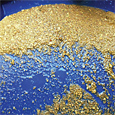
Armed with my heavy bucket of gravel and, most importantly, my gold pan, I anxiously waded knee-deep into the mucky water. At the ready, the swish-swash splish-splash was all I heard as I hurriedly shook my gold pan, turfing out all the bigger bits of rock and clumps of mud. My clean clothes and even my face were soon splattered with mud in my race to pan as much gold in 20 minutes as my spindly arms would allow!Additional articles that might interest you...
New Mining Regulations in Maine
February 2014
Renewed interest in mining of gold, silver, copper and other metals in Aroostook County's Bald Mountain triggered 2012 legislation requiring the overhaul of the state's two-decade-old mining regulations.
Mine Threat Just a Stunt to Criticize Land Laws
November 2004
An environmental group has staked a claim to mine 20 acres of land next to a posh subdivision near Hayden Lake, Idaho, to illustrate how antiquated the nation’s mining laws have become.
Detecting Nuggets—Overcoming New Challenges
September 2015
Depth is not an issue unless the site is thoroughly cleaned of shallow trash, and it is far easier to isolate and remove targets using a small coil in a target rich location.
Continental Drift
November 2003
As soon as reasonably accurate maps were made, 200 years ago, one could not help but note the parallelism of some coastlines with those on other continents. The coastlines of Africa and South America, in particular, are strikingly similar. The first scientist to write on the subject was an Austrian, Edward Suess, who put India, Africa, and South America into a supercontinent he named “Gondwanaland.” But, it was not until Alfred Wegener, a German, came out with his “Theory of Continental Drift” in 1912, that scientists took note.
World Gold Council Launches New Gold Bullion Securities
January 2004
Thanks to the efforts of the World Gold Council (WGC), investors in the yellow metal now have an excellent new way in which to participate in gold’s price movements.
Your Guide to Prospecting in Alaska
May 2013
Alaska is getting a lot of interest these days, not least because of all the gold prospecting shows on television. Hardly a month seems to pass without some new prospecting show being announced, and a couple of the most popular feature Alaska.
Gold in Chihuahua, Mexico
January 2001
Chihuahua, about the size of Oregon, is Mexico’s largest state and one of its most prosperous, with a great influx of foreign capital. The capital city, Chihuahua (pop. 2 million), is 228 miles, by divided highway, south of El Paso, Texas. Topographically, the state can be divided into several provinces, from dry sandy deserts on the north and east, to the forested Sierra Madre Occidental on the west and southwest.
Subscription Required:
The Bawl Mill
• Our Readers Say
• The Public Process—Getting Involved and Making a Difference
• Pacific Northwest Miners Request Help
• USFS Roadless Comments Reopened
• Flat-Fault Gold
• Basic Drywashing Principles
• Fields of Gold
• De Beers Undergoes Overhaul
• Gold in Michigan
• Update on the West Mojave Desert Planning Area
• 2001 Inductees to the National Mining Hall of Fame
• Company Notes
• The Spanish Silver of Mowry
• Melman on Gold & Silver
• Mining Stock Quotes and Mineral & Metal Prices