All Articles
Legislative and Regulatory Update
April 2001 by Scott Harn


The Bureau of Land Management has proposed a rule to substantially increase fees for all document filings related to mining (see chart). BLM says these increases are going to allow them to recover costs associated with processing documents.
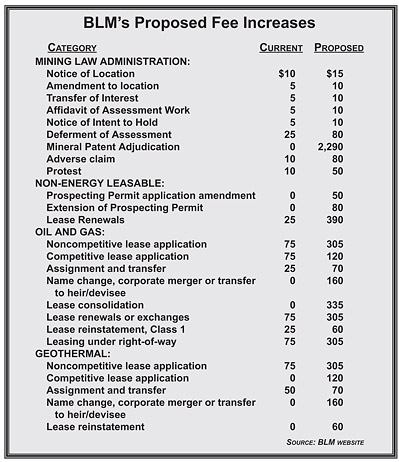
BLM recommends that the Notice of Location fee be increased from $10.00 to $15.00, and all other categories are proposed to at least double.
The fee for filing a protest would go from $10.00 to $50.00. Filing for an extension of a prospecting permit was free, but they propose charging $80.00. Adverse claim filings would increase from $10.00 to $80.00, an increase of 800%.
The comment period expires on April 16, 2001. Please get your comments in before the deadline.
Address email comments to: WOComment@blm.gov and place “AC64” in the subject field to identify the regulation you are commenting on.
Mail comments to: BLM, Administrative Record, Room 401 LS, 1849 C Street, NW, Washington, D.C. 20240.
You can view the entire document at www.blm.gov by clicking on the appropriate regulation, or going to: www.blm.gov/nhp/news/regulatory/ 3000_gp/3000etal.html
• Jumping frog wins federal habitat protection
The California red-legged frog won critical habitat designation on more than 4 million acres of the state.
The red-legged frog already was listed as “threatened,” but the new designation by the US Fish & Wildlife Service exposes developers to greater federal scrutiny by mapping out where frog populations live or could recover.
The government developed the habitat plan after environmental groups successfully sued, claiming the government had to declare a critical habitat for any species protected under the Endangered Species Act.
Environmental groups, including the Center for Biological Diversity, said they were pleased with the ruling but were disappointed parts of the Sierra Nevada—including Calaveras County where Mark Twain set his classic tale “The Celebrated Jumping Frog of Calaveras County”—were not protected.
Even though the frogs have only been found in four areas, the US Fish & Wildlife Service has designated parts of 28 counties as critical habitat. The agency could try to place restrictions on mining and development even if no frogs live in the area.
David Smith, general counsel for the Building Industry Legal Defense Foundation, stated, “We still have grave concerns about it. Because the (Fish and Wildlife) Service blurs the line and treats unoccupied habitat like occupied, land that should be free of regulation is inappropriately pulled in.”
• NMA challenges “midnight” water regulation
The National Mining Association petitioned a federal court to overturn stringent new arsenic drinking water regulations issued in the final days of the Clinton Administration.
The new rules, published the day after President Clinton left office, were in spite of congressional efforts to have the Environmental Protection Agency develop better scientific evidence on the risks of arsenic in water.
NMA’s comments said that while the mining industry supports the goals of the Safe Drinking Water Act and agrees it is essential to ensure the safety of our water supply, it is also critical that there be a basis of sound science and consideration of the benefits and costs that Americans will experience.
The acceptable level of arsenic in drinking water was 50 parts per billion (ppb). EPA’s new standard would reduce the acceptable level by 80 percent, well below levels that often occur naturally in water supplies.
“The final rule was a political decision and is not supported by science,” NMA said. “EPA itself admitted it was ‘unable to specify a safe threshold level’ and EPA’s own Science Advisory Board criticized the proposed rule as unjustified by the evidence and prohibitively expensive.”


Mining Stock Quotes and Mineral & Metal Prices
Legislative and Regulatory Update
• Battle continues in the "Golden State"
• California Water Board needs your comments
Gold in the Rattlesnake Hills
The Rattlesnake Hills (RSH) in central Wyoming had been overlooked for gold, even though it had all of the earmarks of being a major gold district.
The Wisdom of Mark Twain—And Tales of Cheating the Unwary Prospector
I (enjoy) Twain’s description of a gold mine, “A hole in the ground with a liar at the top.” Some humor here? You bet, but I’m sure he meant it to be a real eye opener as well.
California State Open and US National Gold Panning Championships
One hundred eighty-six panners went through a wild and woolly two days (August 30 & 31 in Foresthill, Calif.) to determine who had the bragging rights of being the best—at least for one year!
Learning the Game and the Power to Change It
The one legal entity that can change the game and provide a path and template to protect landowners and public land users across the United States is the miner.
Police Urge Author to End Treasure Hunt
The plea from State Police Chief Pete Kassetas follows what authorities believe is the latest death related to the effort to uncover Forrest Fenn’s treasure.
Subscription Required:
The Bawl Mill
• Our Readers Say
• Gold & Fish in Washington
• Original Sixteen to One Goes to Court—Challenges MSHA Citations
• The Great Gold Rush of Nome, Alaska
• Picks & Pans: Red Mountain Planted Nugget Hunt
• Silver at Calico, California
• The South Pass Gold Placers, Western Wyoming
• Discovery of the Silver Bullets
• Tonopah Historic Mining Park
• Melman on Gold & Silver
• Mining Stock Quotes and Mineral & Metal Prices
• Mine Forced to Pay for Grizzly Habitat and More
Free: