Prospecting & Detecting
Backwards Find
July 2013 by Joe Chmiel


I like to hunt club claims, and I find that by maneuvering my coil between rocks and bushes I can sometimes pick out a nugget—or five or six—that others have missed. On this particular day, I was doing my usual thing, picking off nuggets up to 1/2-gram in size. However, my prospecting partner, instead of skimming along the surface, seemed to be lingering extra long in just one place. In fact, he was practically camped on this single spot, digging, detecting, recovering, and repeating the process.
It occurred to me that he might have found a cluster of extra tiny nuggets, the type that only his VLF (very low frequency) detector can pick up. Or maybe he was having trouble pinpointing the responses his detector was giving him. Whatever it was, I knew I had better stay busy if I were to keep up.
Of course I became so engrossed in what I was doing that I failed to notice that for a full two hours my partner had been trying to get my attention to come join him, and he was in a bit of a dilemma about this. On the one hand, he could leave his spot and come get me (running the risk of other nearby nuggetshooters jumping his hole) or he could yell to me to come over (thereby signalling to everyone around that there was something worthwhile to be had). Well, he did neither—he chose to wait until I finally noticed his subtle gesturing and walked over to see what was up.
I was surprised to see that he had a two-foot deep hole going and had already collected about 15 grams worth of nuggets. As for me, I was barely over one gram for my day’s efforts.
Seeing as I was swinging a different VLF detector that wouldn’t interfere with his, he suggested that I dig a hole about 10 feet away from him to see if I might find a similar pocket. It was late in the day and I was already a bit worn out, so I was not looking forward to digging in the blind hope of hitting a pay streak.
.jpg)
But dig I did—and without the benefit of a detector signal, mind you. Picking my way through the bedrock, my hope of hitting a gold-bearing pocket was fading with the late afternoon sun. As soon as I got under the bedrock and into a soft layer I stuck the coil of my detector into the hole. Wham! A solid “zeet-zeet” from the side of the hole greeted my ears, and turning the discriminator function on yielded a solid indication for gold on the detector’s readout.
I furiously started pulling material out of the side wall and putting it in my scoop. It didn’t take long to discover that the source of the scream was from a one-ounce chunk of rock. Almost no gold was immediately visible due the rock being encased in a hardened caliche crust, but one corner gave away its secret. An exposed area of yellow metal indicated that this was indeed a temporary treatment for my gold fever!
I wanted to jump up and down, but because of the other detectorists in the area, I had to play it cool. The prize was slipped quietly into my pouch with no celebration. It was only upon later inspection that I could see this rock was ribboned with gold!
The total weight was just over an ounce, and with some cleaning it will end up under an ounce. But still, finding a specimen piece of this size was a real treat. Oh yeah—the hole held a couple more tiny nuggets and nothing else.
So I guess this was sort of a backwards find. Instead of beeping a target and digging a hole, I dug a hole and then beeped the target. Gold is indeed where you find it!

Mining for Gemstones and Mineral Specimens
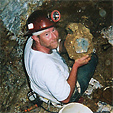 It is better in a gem and mineral mining operation that the driller, blaster and mucker be the same person in order to be able to predict placement of the desired mineral enriched pockets.
The Hunch
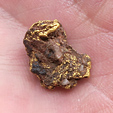 The mysteries of this spot were only just starting to develop. There is nothing but very bland granite-type rocks here, meaning no bold, favorable indicators.
Panning for Gold on Canyon Creek
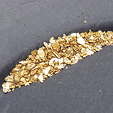 I was able to remove the gravels with the assistance of a crowbar and I scooped them up with a garden trowel. This gravel contained over a pennyweight of gold and there were several 2-grain and 3-grain pieces…
Finding Gold with a VLF Detector—Part II
 It is this ability to hear and respond to the faintest of audio signals that I believe separates the best nugget hunters from everyone else.
My Lucky Thirteen Nuggets
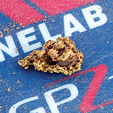 Even with my favorite top-of-the-line gold detector there were several false digs. Many of the hot rocks gave a solid signal that was too much like a nugget to ignore. After trying several tests I just dug everything because it is better to be safe than leave a big, deep nugget for a more diligent gold hunter.
Small-Scale Processing of Hard Rock Ores
 Depending on the ore and if significant sulfides are present, a hard rock miner may be able to get away with simply using a flux to digest the other minerals that may be present.
Tucson Show Marketing
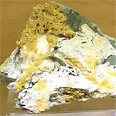 Normally we do not cover gem and mineral shows, but this one is a little different. The Tucson (Arizona) Gem and Mineral show is the sales source for so many small mining operations, I felt I had to address this show and its possibilities for the small miner.
Subscription Required:
The Bawl Mill
• Ask the Experts
• Ask the Experts
• The Birimian Greenstone Belts of West Africa
• Study Confirms Mercury Levels Safe in California's Gold Country
• All About Quartz—Part II
• The Pearce Mineralized Area, Dragoon Mountains, Arizona
• An Alaskan in the Lower 48
• Romancing the Rock
• Placer Channel Sampling
• The Oquirrh Mountains, Utah
• Melman on Gold & Silver
• Mining Stock Quotes and Mineral & Metal Prices
• Record $11 Million Fine for California Mine
Free:
Legislative and Regulatory Update
• Balmoral Resources